













#38,021: Ghost Rider (2005) #1
"The Road to Damnation, Part I"
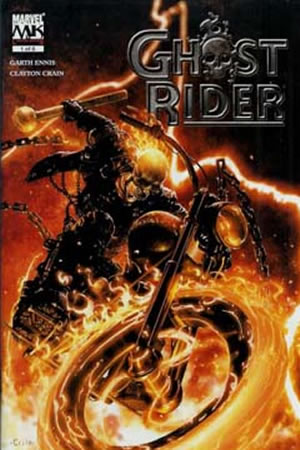
Title: Ghost Rider (v005)
Editor-in-Chief:
Joe Quesada
Editor:
Axel Alonso
Writer:
Garth Ennis
Artist:
Clayton Crain
Inker:
Clayton Crain
Cover Artist:
Clayton Crain
Colorist:
Clayton Crain
Letterer:
Chris Eliopoulos
Cover Date: November 2005
Release Date: September 2005
Pages: 22
Cover Price: $2.99
Times Read: 146
Times Rated: 83
Universe:
Earth-616


Loading...
Log in to post a comment.
5 Comments
Sort:
JWC
Mar 29, 2026
At this point in my reading I approach any Garth Ennis MU story with trepidation. Ennis and I just aren't getting along at this point. Anyway, I was wondering if we were in a Johnny Blaze or a Danny Ketch situation here so I glanced at the Appearances tab. I still don't know (I'm hoping for Danny, but I doubt it) because I noticed a character named Buttview. Sigh.
imredjimmy
+1
Sep 19, 2025
This follows a similar story structure to what we've been seeing in Ennis' Punisher MAX series. Which is that we dont really follow the title character but rather spend time with the worst a-holes you've ever met who blab on for 20 pages. Except here instead of gansters it's angels.
I mean there's potential here. The art is pretty metal and going to hell stories can be real fun.
I mean there's potential here. The art is pretty metal and going to hell stories can be real fun.
Jan 25, 2025
Catch-22 (1961) is an absurd, satirical novel, set during WWII, by American Joseph Heller. A "Catch-22" is "a problem for which the only solution is denied by a circumstance inherent in the problem or by a rule". For instance, you'd have to be crazy to fly a bomber into combat. But if you're crazy, you're not allowed to fly. However, explaining you're too crazy to fly, proves you are sane, so you must fly. But, if you fly, you're crazy.
Malachi is quoting the example above, from the book, when he say, "There was only one catch and that was Catch-22..."
Malachi is quoting the example above, from the book, when he say, "There was only one catch and that was Catch-22..."
Jan 25, 2025
Dated References:
My Lai (1968) was an insignificant village that was the site of an American war crime during the undeclared wa... 'Vietnam Police Action'. Between 350 — 500 old men, women, and children were slaughtered and numerous women and girls were raped first. Only one helicopter crew made a serious effort to stop the killing. The entire chain of command was implicated in the massacre or its cover-up. However, only the lower ranks were ever charged with a crime. The soldiers relied on the so-called 'Nuremberg Defence', invoked by numerous Nazis, that they were, "Just following orders." This defense, deemed unacceptable in Germany, was accepted here. Only one soldier was convicted, in 1971. Lt. Calley was sentence to life, at Leavenworth, with hard labour. He was released, on parole, in 1974.
The "My Lai Air Cavalry" is a reference to this atrocity. But why would anyone mix these real, tragic events in with fictional demons?
(Ghost) Riders in the Sky: A Cowboy Legend (1948) is a song by American Stan Jones. It's allegedly inspired by an Apache legend. It tells of a wayward cowpoke who has a vision of damned cowboys, on fire-breathing horses, chasing flaming cattle across the sky. The song was quite popular, with four different versions charting on Billboard in 1949. Since then, it's been covered by Johnny Cash and many others. The song may have inspired the first Ghost Rider (1949), who later became a Marvel character (1966) (and is now known as the Phantom Rider). There's an obvious parallel with the modern Ghost Rider (1972).
In a bit of foreshadowing (I guess), Hoss is singing the song when he encounters the bikers.
My Lai (1968) was an insignificant village that was the site of an American war crime during the undeclared wa... 'Vietnam Police Action'. Between 350 — 500 old men, women, and children were slaughtered and numerous women and girls were raped first. Only one helicopter crew made a serious effort to stop the killing. The entire chain of command was implicated in the massacre or its cover-up. However, only the lower ranks were ever charged with a crime. The soldiers relied on the so-called 'Nuremberg Defence', invoked by numerous Nazis, that they were, "Just following orders." This defense, deemed unacceptable in Germany, was accepted here. Only one soldier was convicted, in 1971. Lt. Calley was sentence to life, at Leavenworth, with hard labour. He was released, on parole, in 1974.
The "My Lai Air Cavalry" is a reference to this atrocity. But why would anyone mix these real, tragic events in with fictional demons?
(Ghost) Riders in the Sky: A Cowboy Legend (1948) is a song by American Stan Jones. It's allegedly inspired by an Apache legend. It tells of a wayward cowpoke who has a vision of damned cowboys, on fire-breathing horses, chasing flaming cattle across the sky. The song was quite popular, with four different versions charting on Billboard in 1949. Since then, it's been covered by Johnny Cash and many others. The song may have inspired the first Ghost Rider (1949), who later became a Marvel character (1966) (and is now known as the Phantom Rider). There's an obvious parallel with the modern Ghost Rider (1972).
In a bit of foreshadowing (I guess), Hoss is singing the song when he encounters the bikers.
Sep 24, 2024
The art is nice but that's about it.