












Review of
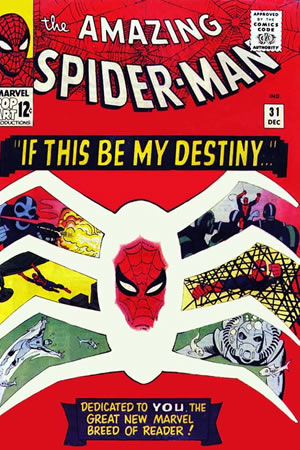
Amazing Spider-Man (1963) #31
Published:
December 1965
Reviewer Rating:
Avg User Rating:
(3.92)

A New Era Begins
Amazing Spider-Man #31 is messy, overloaded, and occasionally frustrating, but its undeniably pivotal. Acting as a soft reset for Peter Parkers world, the issue transitions him from the familiar halls of Midtown High into college life, expanding the scope of the series while planting the seeds for one of Spider-Mans most legendary arcs, If This Be My Destiny...
The most fascinating element is the debut of Gwen Stacy and Harry Osborn. Modern readers may be surprised by how abrasive they initially appear. Rather than instant allies, both come off as judgmental and clique driven, with Harry in particular bordering on openly hostile. Gwens early dynamic with Peter mirrors Liz Allans high school tension, reinforcing how Stan Lee and Steve Ditko leaned into social friction before gradually reshaping it into something more meaningful. Their rocky introductions make their future evolution all the more compelling.
Peters emotional turmoil anchors the issue. Aunt Mays sudden illness once again weighs heavily on him, pushing him into isolation and making him seem arrogant or antisocial to his new classmates. While Mays recurring health crises can feel repetitive, they effectively underscore the crushing responsibility that defines Peters character. Ditkos artwork shines here, using expressive body language and sharp panel composition to convey Peters anxiety in ways the occasionally exposition heavy dialogue cannot.
The Spider-Man action itself feels secondary. The Master Planner subplot introduces a mysterious, Bond style villain orchestrating an ambitious uranium theft, but the henchmen lack personality and the conflict functions primarily as setup.
Structurally uneven yet thematically rich, Amazing Spider-Man #31 marks the beginning of a more mature, emotionally layered era for the character.
Final verdict: 8.12/10
Amazing Spider-Man #31 is messy, overloaded, and occasionally frustrating, but its undeniably pivotal. Acting as a soft reset for Peter Parkers world, the issue transitions him from the familiar halls of Midtown High into college life, expanding the scope of the series while planting the seeds for one of Spider-Mans most legendary arcs, If This Be My Destiny...
The most fascinating element is the debut of Gwen Stacy and Harry Osborn. Modern readers may be surprised by how abrasive they initially appear. Rather than instant allies, both come off as judgmental and clique driven, with Harry in particular bordering on openly hostile. Gwens early dynamic with Peter mirrors Liz Allans high school tension, reinforcing how Stan Lee and Steve Ditko leaned into social friction before gradually reshaping it into something more meaningful. Their rocky introductions make their future evolution all the more compelling.
Peters emotional turmoil anchors the issue. Aunt Mays sudden illness once again weighs heavily on him, pushing him into isolation and making him seem arrogant or antisocial to his new classmates. While Mays recurring health crises can feel repetitive, they effectively underscore the crushing responsibility that defines Peters character. Ditkos artwork shines here, using expressive body language and sharp panel composition to convey Peters anxiety in ways the occasionally exposition heavy dialogue cannot.
The Spider-Man action itself feels secondary. The Master Planner subplot introduces a mysterious, Bond style villain orchestrating an ambitious uranium theft, but the henchmen lack personality and the conflict functions primarily as setup.
Structurally uneven yet thematically rich, Amazing Spider-Man #31 marks the beginning of a more mature, emotionally layered era for the character.
Final verdict: 8.12/10